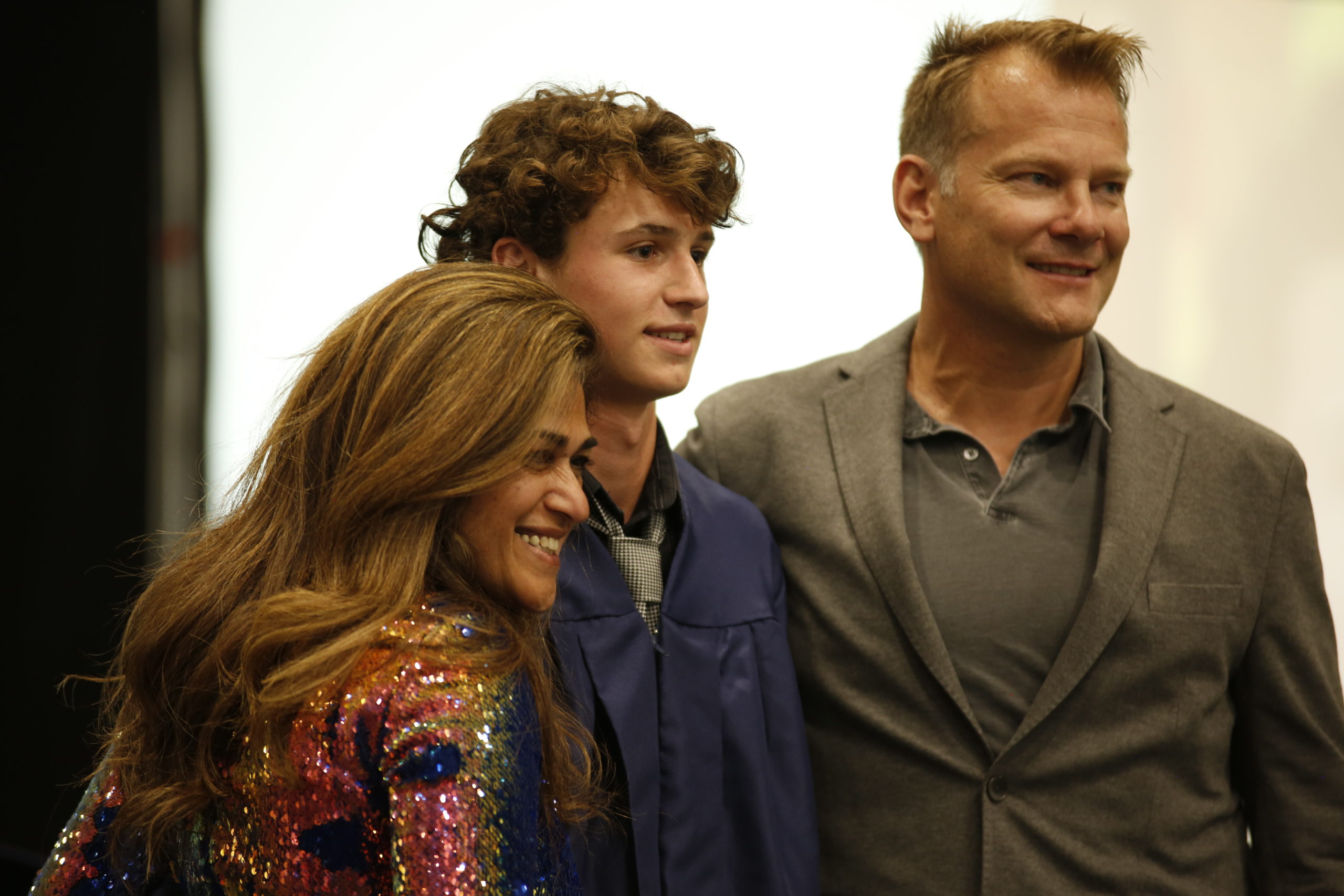
Photo courtesy YSC Academy from 2020
In November of 2016, YSC Academy founder Richie Graham introduced his school to the public at an open house held in its temporary academic spaces in Wayne, PA across the street from what is now called YSC Rocket Sports. (Click here for PSP’s report of the November, 2016 event.) His academy would graduate its first senior class the following June, and it was time publicize those seniors’ achievements.
In the introduction’s opening question-and-answer session that allowed unscripted questions from the floor, then Union Sporting Director Earnie Stewart, himself a U. S. World Cup veteran, expressed the hope that someday the Union’s Academy might contribute players to the United States Men’s National Team at a World Cup. After Stewart, then Union head coach Jim Curtin emphasized that the academic education the boys were receiving was substantive not ephemeral. Mr. Graham’s academy would equip its graduates to thrive as adults in their lives after soccer.
A decade later Mr. Graham’s academy has emphatically achieved Director Stewart’s hope. It has contributed four Alumni to a U. S. World Cup roster, among the highest total of any MLS club if not the highest.
The evidence
In birth date order the four Philadelphia Union alumni who are rostered to the 2026 World Cup with the United States are listed below. We provide cogent athletic and intellectual details.
- Left-foot center back Auston Trusty, birthdate 8/12/98 so age 27.8, now plays for Celtic in the Scottish Premiership. Trusty completed a business program at the Harvard Business School in 2023, suggesting he must have previously earned a bachelor’s degree of some kind somewhere at some time.
- Goalkeeper Matt Freese, birthdate 9/2/98 so 27.7, now plays for New York City FC in Major League Soccer. Freese earned a bachelor’s degree in economics from Harvard University in 2022.
- Right-foot center back Mark McKenzie, birthdate 2/25/99 so 27.2, plays for Toulouse in France’s Ligue 1. After a semester at Wake Forest, he left school to sign with Philadelphia as a Homegrown. Since leaving Philadelphia, he played with Genk in the Flemish region of Belgium for 31 months before moving to France in August of 2024. We assume that by now he can get by in three different languages: Flemish, (a derivative of Dutch apparently), and French, as well as English.
- Right-foot attacking midfielder/winger Brenden Aaronson, birthdate 10/22/00 so 25.6, plays for Leeds United in the English Premier League. As far as artificial intelligence can discover Aaronson has not yet formally pursued further education after high school. Just last weekend he married his long-time sweetheart, former collegiate soccer player Milana D’Ambra herself daughter of a college coach, taking a 24-hour leave last Friday from coach Pochettino’s U. S. training camp to do so. Having played in Austria for 18 months before going to England, we assume he can get by using German. (Writer’s note: our feature photo is not of Brenden Aaronson’s graduation from YSC in 2019 but of younger brother Paxton’s in 2020.)
While they were part of the Philadelphia Union’s Academy, all four dressed as amateurs for the Philadelphia Union’s affiliate in the USL Championship, Bethlehem Steel FC, and the three field players played extensive game minutes while amateurs. Freese never played while an amateur but two years later and more he played quite a bit as a professional. All four became first-team Homegrown players for the Union itself. And all four were sold onward to other clubs, as we note below.
- Trusty first went to Colorado of MLS after 2018, then to Birmingham City of England’s second-tier Championship League while on a loan from his contract holder first tier Arsenal. Then he went to Sheffield United at the time in England’s first tier, and finally to his current five-year deal with perennial Scottish Championship contenders Celtic.
- Freese was traded to NYC FC before the 2023 season. After the next year, he revived a dormant club award when NYC named him the team’s most valuable player They had not presented that award in either 2022 or 2023. He is unofficially rumored to be a strong candidate to start in goal for the United States at the World Cup.
- McKenzie first went to Genk in Belgium’s highest division, and then on to Toulouse in France’s Ligue 1. His systematically analytical personality has always taken its time when adjusting to new environments. But once he figures it out he does well.
- Aaronson first went to Salzburg in Austria, then to Leeds United of the English Premier League. For the 2023-24 season he was loaned from Leeds to Union Berlin of Germany’s Bundesliga since Leeds had been relegated to the Championship. He returned to Leeds when they re-ascended.
To date Mr. Graham’s academy has fulfilled Director Stewart’s anticipated world cup role well.
Analysis
PSP believes that a key factor in the successes of these four may have been the quality of their stepping-stone from the Academy to Major League Soccer. Back then it was the USL Championship , not MLS NEXT Pro as it is today. We see clear differences between the two leagues.
Back when these four players were playing in the USL Championship, they competed against teams of fully-grown, fully matured adults. Also, the gap between the first team’s league and the farm-team’s league was not as great as it seems to be now. MLS itself has improved its quality of play recently and caused some gap widening thereby. But MLS NEXT Pro today seems distinctly lesser than USL-C was then.
Shortly before his recent departure, Bradley Carnell used the word “vast” to describe today’s difference between MLS and MLS NEXT Pro. Part of Carnell’s “vastness” is that MLS Next Pro is lesser than its predecessor.
Jumping the gap
The fastest Union player to rise from MLS NEXT Pro’s level to MLS itself will be Cavan Sullivan. Barring setbacks, he should have fully achieved that jump in all facets of his game by November of this year.
Other Union players have made the same jump, but nowhere nearly as rapidly. It is a big jump and assimilating themselves to all the differences has taken all the others more time.
- Cavan’s older brother Quinn did not achieve the jump fully for two or three years arriving fully last year in 2024.
- Despite his magical left foot, Jack McGlynn’s athleticism never managed to excel against top MLS opponents, leading to his sale to Houston.
- It took David Vazquez more than two years and a change of club to complete his full jump to MLS.
- Only this year has Jesus Bueno shown signs of emerging as a starting caliber MLS player, having first arrived in Chester playing for Union II five years ago.
- Nathan Harriel began at the Academy in 2018 and became a first team homegrown in 2021, the year of Bueno’s arrival. He arrived as an MLS starter a year faster than the Venezuelan.
- Frank Westfield is on his way to starter status, but his journey does not yet approach Kai Wagner.
- After the Sullivan’s, Andrew Rick is probably the most advanced of the first team’s MLS NEXT Pro alumni. However, as the Union goalkeepers are their own special developmental category, We are comparing apples to an orange.
In earlier years, stepping up from the USL Championship to Major League Soccer was also slow and hard. None of the three field players discussed above did it as fast as Cavan Sullivan will. But they became better prepared to face MLS than the veterans of MLS Next Pro did.
- It took Trusty two full seasons in USL to convince Curtin that he was ready to be handed the keys to being an MLS left center back.
- McKenzie was not cemented into place until after more than a year and a half of transition and learning.
- Aaronson also took a year and half before he became a consistent MLS offensive threat.
But unlike the MLS NEXT Pro products, in none of the USL-C developmental cases did the ability to survive MLS’s physicality become an issue.
The difference between the two leagues may be best illustrated by C. J. Olney.
In MLS Next Pro Olney became a highly successful, game-changing midfielder. But he never convinced Carnell he could play in MLS, perhaps because he is slight and wiry. This year Carnell sent him out on loan to the USL Championship, to Brooklyn where his old coach Marlon LeBlanc installed him as a full-time starter immediately.
The loan may succeed in bringing Olney back to the Union if his fundamental statistics qualify him. If they do and he returns, his having proven that he could survive USL-C’s physicality may have been a key achievement.
Hopefully by October, a better illustration than Olney may be Neil Pierre. But we have yet to see what six months in the Danish second division have added to the “physicality survival quotient” of the young left center back’s play.
We end these remarks on physicality by recalling a near-disaster that occurred in late April of 2018 when Brenden Aaronson was playing for Bethlehem Steel FC against FC Cincinnati at Lehigh University’s Goodman Stadium. Cincinnati center back Forrest Lasso crunched Aaronson just outside Cincy’s penalty box. and caused quite the drama. The smaller Bethlehem man had to be stretchered off immediately using a gurney. He was driven to a hospital’s emergency room by ambulance. His green-stick fractured collarbone was on the verge of poking through his skin to become a compound fracture. That is a medical predicament much more dangerous than its predecessor because of the potential for infection. It took Aaronson 10 weeks to recover from Lasso’s hit and return to play.
The Cincinnati Enquirer asserts that Aaronson credits the injury and its recovery process as the catalyst that gave him his final mental push to pursue a permanent jump to MLS. Lasso was two or three inches above six feet tall, 25 years old, and — by eyeball — probably 200 pounds or more. Aaronson was 17 at the time, and eight years later at 25 he stands 5’10” and weighs about 150 pounds. Back then he was smaller and most definitely lighter.
We assert that the physical challenge of the USL Championship was an important aspect of its success as a player development league, not only for Aaronson but for everyone else who played in it.
Today is an additional developmental step needed?
The Carnell quote cited earlier suggests the answer is yes.
Speculation about the stated reasons Union ownership gave to explain purchasing its small minority stage in Danish side Lyngby Boldklub gave rise to stepping-stone speculation about a purpose of the acquisition. Ownership’s descriptions of the various symbioses it expected the relationship to create did not exclude a stepping-stone role. But logic suggested that only one player at a time would seem a likely parameter, should a Lyngby stepping-stone experience prove fruitful to both parties.
No fact-based assessment of the role that Lyngby’s relationship with Philadelphia may play in the future is yet possible because eyeballing Pierre’s results in practice on a pitch will not be possible until June 15.
And no one stateside without an insider’s access to Lyngby practice videos or the ability to view Danish second-division game tapes has yet seen Neil Pierre’s play during or after Denmark. To suggest that in future the Danish club might serve as a finishing stepping-stone towards MLS for a select one or two players remains premature.
If not Lyngby, … .
But Neil Pierre’s return is not the only current event to potentially to develop an additional step in a pathway towards the first team.
Brooklyn FC is close by. It has a coach well-known to Philadelphia. And it plays in the previously discussed USL Championship. Now that Jon Scheer is Sporting Director, if the Union’s applicable first-team thresholds were to permit it, loanaways from Chester to Brooklyn may no longer mean the everlasting banishments they had seemed to mean under Ernst Tanner.
Should C.J. Olney return to Chester next year as a candidate for the sprint season’s roster, an alternative additional stepping-stone towards the first team may have emerged.
Our Brooklyn speculation cannot be validated or disproved until roster decisions are announced after the close of play this fall.
Finally, to step off the speculative deep end most thoroughly, every YSC Academy graduate is required to take at least three years of Spanish to graduate. Might a player development relationship be explored with one of the perennially lesser teams of Liga MX?

RECENT COMMENTS