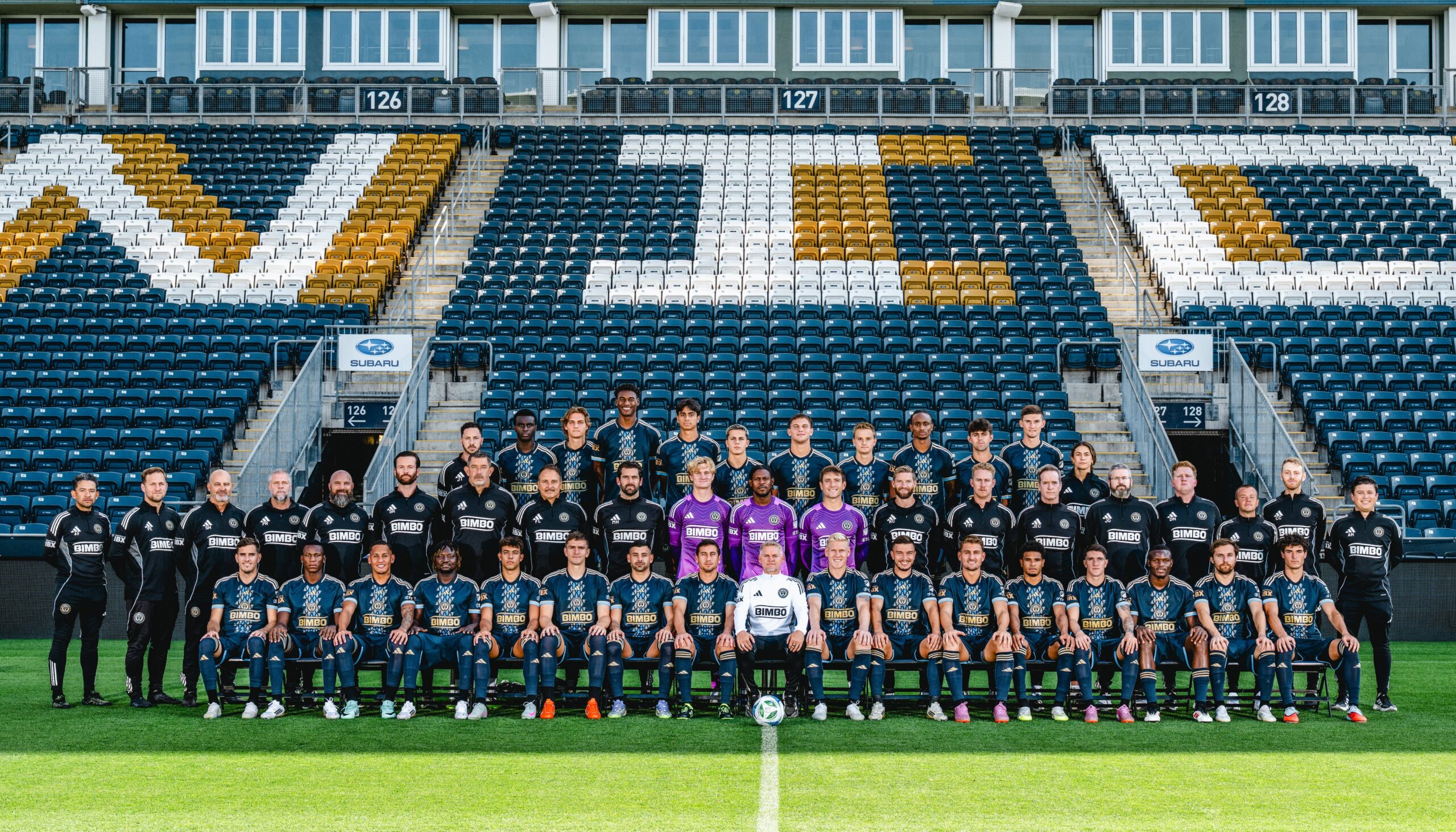
Photo courtesy Philadelphia Union Communications
The Philadelphia Union has not started its 2026 Major League Soccer season well. That should surprise no one. It is a different team from the veteran one pictured above that won the 2025 Supporters Shield. Its 2026 Major League Soccer start now matches the poorest in the club’s MLS history.
The 2026 challenge of the Concacaf Champions Cup is now compounding the poverty. Right now, the contrast between 2026’s version of the first team and 2025’s is stark.
Then
In 2012, the Philadelphia Union’s 3rd season of play in Major League Soccer, they opened with three consecutive losses.
- March 12, 2012: Portland Timbers 3–1 Philadelphia Union
- March 18, 2012: Philadelphia Union 1–2 Colorado Rapids
- March 24, 2012: Chicago Fire 1–0 Philadelphia Union
On May 26th, 2012 they lost to winless Toronto in Toronto and the then managing executive Nick Sakewiecz fired head coach Peter Nowak, replacing him with John Hackworth. Their record in their first 11 games had been two wins, seven losses, and two ties.
Now
This year the Union has again opened the MLS season with three consecutive MLS losses.
- February 28, 2026: D. C. United 1-0 Philadelphia Union
- March 1, 2026: Philadelphia Union 1-2 New York City FC
- March 7, 2026: Philadelphia Union 0-1 San Jose Earthquakes
Overall to date in both MLS and the Concacaf Champions Cup, Philly has won two, lost four, and drawn none.
The losses themselves are a concern.
But they are perhaps less of a concern than having gone a full 270 MLS minutes without scoring from the run of play (plus 90 more if you add Tuesday night’s CCCup shutout by Club America). The Union have seemed mostly inchoate when in possession of the ball in the offensive half, especially in the final third, and most worryingly they have not been clinical at all when trying to finish against opponents who play at their level or higher.
When they have managed to create play and connect passes with sustained consistency against comparable teams, the opposition has been parking the bus at the ends of games, as Club America did successfully on Tuesday night, March 10th in its 1-0 Concacaf Champions Cup Round of 16 first leg win in Chester.
Consider the number five.
Many pundits have incorrectly focused much verbiage on the number four, the four starters the Union sold away or let walk during the offseason. But four is incomplete. Those pundits omit the fifth key starter who is also unavailable, but not – at least not until he proves full knee recovery – due to his being sold. Full marks to PSP colleague James McCrone who first mentioned him.
Quinn Sullivan is not in 2026’s attacking midfield. In 2025 he started 24 of his 28 MLS game appearances before tearing a knee ligament. Sullivan, Milan Iloski and Indiana Vassilev were last year’s three top attacking midfielders after Iloski had joined in late summer. And 2025 had many fewer midweek games than does this. That means missing an attacking mid from rotational availability matters more this year than it would have last. 2026’s attacking midfield is also weaker disproportionately because it is Sullivan who is missing, His speed, endurance, and ground coverage are hugely important defensively in the press.
Vassilev is less of a creator than the other two. He works hard and complements Sullivan and Iloski very well but he does not create as much offensive play as they do. And Iloski, while he is effective at attacking mid, when there he is playing away from his better position which is striker. Sullivan’s absence means the Union’s attacking midfield is weaker this year than it was last.
Another major point flows from the number five.
As many as half the ten starting field players may be having to learn the Union’s system all together at the same time, especially to the instinctive “without thought” level that has been proven necessary for success in MLS. By memory, that is the highest percentage of concurrent new learners since the Union first switched to the press after Sporting Director Ernst Tanner’s arrival. Of this year’s neophytes a center back (Japhet Sery) and a left back (Philippe Ndinga) come from the defense. No one comes from the defensive midfield. Two (Agustin Anello and Ezekiel Alladoh) come from the strikers. We have already discussed the older Sullivan’s attacking midfield absence, the replacement of which is being covered by Iloski who only began playing Carnell’s system last August.
Further related to the number five but indirectly so is a part of the reason newly promoted striker Stas Korzeniowski has been showing so well. He already knows Carnell’s version of the club’s system and how to maximize his play within it. His presence increases the percentage of field players who know it by ten. By comparison fellow strikers Alladoh and Anello are in only the first stages of learning. Under Jim Curtin it sometimes took six months before a new player became instinctive, sufficiently conditioned, and fully integrated at MLS’s level.
Getting to know the system
We have no data for how long a new person may take to learn from Bradley Carnell because in the only potential example from last year was derailed by Ian Glavinovic’s early injury and Olwethu Makhanya’s concurrent success. Since Makhanya had had a full year and more in the system with Union II, no one new to the principles had joined the primary players under Carnell until Iloski arrived August 5th.
In 2018 when Tanner arrived and changed the formation to two strikers integrated with a pressing midfield, it took Jim Curtin months of 2019 to teach the team how to play together that way. Later on, older players with lots of experience integrated into the side more rapidly, but they were doing it one at a time. Daniel Gazdag joined in June 2021, just before leaving to play for Hungary in the Euro tournament of the day. He had deliberately jump started his learning process. And the most experienced of the earlier group Mikael Uhre hit the ground running in 2022, although his defensive instincts were not as immediate as they later became.
In 2026 the new players are less experienced, younger, and they are all learning simultaneously. Julian Carranza had already been here when Gazdag arrived. In turn Gazdag had already learned a lot before Uhre arrived. Alladoh and Anello have joined almost simultaneously. Especially for attacking play, Carnell’s 2026 pedagogical challenge is greater than any Curtin faced after his initial one in the 2019 season.
An additional major point is that it may have been deliberate that the Union’s 2026’s preseason included less difficult opponents than it had in 2025. They needed to experience some initial successes. But there are follow-on consequences. The Union is not as ready for MLS competition as it might be.
In only the second half of its last preseason scrimmage did Philadelphia face the intensity and physicality of a Major League Soccer team’s number ones, against CF Montreal in Clearwater on February 10th. Preseason installed the system effectively for play against lesser sides, as the performances against Defence Force of Trinidad and Buducnost Podgorica of Montenegro suggest. The Czech side Olomouc and Danish one Nordsjaelland had been more challenging opponents on the Costa del Sol. But in Florida the Tampa Bay Rowdies were not MLS quality. The absence of the usual Florida match against FC Cincinnati figures prominently.
Philadelphia still has to learn how to play against MLS speed, intensity, and physicality. They must use their the earliest MLS regular season games as their classroom. In some ways it seems that the first nine games of the regular season are not being treated a full regular season events. The top eleven are not being run out consistently. Yet it would be wrong to call these games an extended preseason because they count. Right now teaching, evaluating, and conditioning remain major objectives equal in value to winning.
Roster players need to gel
The final roster piece only just arrived stateside last Friday, February 27th. Left back Philippe Ndinga from Congo (Brazzaville) debuted impressively for 80 minutes against Club America Tuesday night. He will be catching up to his fellow new arrivals who are themselves catching up to the Union’s system and the nature of MLS play.
Carnell’s side has made progress. Except for a prominent veteran of Europe’s top levels perfectly picking the penetrating pass to barely catch out a Union II player making his MLS debut with the first team at left back, the San Jose match would have been a mutual clean sheet draw. Such optimism could not have been credibly voiced after the club’s first half of play down in D. C.
Jim Curtin always commented that for Philadelphia to be successful the whole had to be greater than the sum of its parts. Bradley Carnell must create a new whole from yards of fresh new cloth this year. Last year he only had to revive and re-inspire a veteran side that already knew how to play together within a pressing system. This year we will discover how well he can teach new material to multiple new students at once. He will need time to carry out the process.
Our final point concerns the opening-of-season schedule. Had the league’s commissioner directly ordered the Union to be screwed deliberately – he did not as far as we know – the schedule could not have been any less kind to Philadelphia than it has been and is. They began a self-declared roster rebuild year with nine games in their first 32 days. Only once in that first month did they have a proper full recovery interval between games, and that recovery interval was six days not seven.
Travel and schedule
In our discussion of the opening schedule we have not mentioned either travel or altitude.
A Washington, D. C. tap-off three days after a final whistle in Port-of-Spain, Trinidad presented a major challenge. That the Union flew home to Philly for the first time since having arrived in Clearwater, before turning immediately around to travel to D. C. the next day compounded the challenge. If they existed at all, preparation time and practice opportunity must have been tight .
And while the timing of the trip to Mexico City for Club America will be less difficult, play will occur at an altitude of 1.4 miles, between 7,200 and 7,300 feet. Altitude matters. In the People’s Republic of China the trucks in a convoy of goods from the lowlands onto the Qinghai plateau may make the entire journey unbroken, but the drivers cannot. Drivers must be replaced above 10,000 feet.
Two years ago when Philadelphia attempted something similar against Pachuca in the same competition, Mexico took yet another installment of its revenge for General Winfield Scott’s 1848 invading success in what U. S. history textbooks call the Mexican War. At 7,843 feet on March 12, 2024, Pachuca beat the Union 6-0. It was the second leg of the Round of 16 of the 2024 Concacaf Champions League (as the competition was then called).
It remains the heaviest individual match defeat in Philadelphia Union history.
What lies ahead
By the time FIFA’s late March international break arrives, Philadelphia will be battered and bloodied. Time will unfold how badly, and only time will tell whether Union spirits remain unbowed.
April and May will follow with two months of continuing teaching and further refining of both their defensive competence and their offensive coherence. Then June and July will provide a 59-day break — specifically Philadelphia’s case — from official play while MLS accommodates FIFA’s World Cup.
Based on internet rumor we suspect Olwethu Makhanya may have departed for Europe by the end of the break. And we expect Neil Pierre will come back from Denmark by June 30th as scheduled. If correct that would mean another major roster adjustment to the defense. By then Geiner Martinez’s current full-game endurance issues will need to have been resolved. Pierre and fellow 19-year-old Finn Sundstrom are strong prospects but not proven MLS center backs.
Coach Carnell already knows how the club intends to handle two months off. He played seven seasons in the Bundesliga from 1998 through 2005 and must have experienced a full blown World Cup hiatus in 2002.
Union fans will have no long-term idea what their rebuilt side may look like until mid-August at the earliest this year. MLS will have resumed and the Leagues Cup will have recurred. Not even Philly Soccer Page’s infamous, cracked, cloudy, and inaccurate crystal ball is producing any predictions about playoffs. There are too many unknowns.
Postscript
After 2026 finishes, Philadelphia will essay the truncated transition of the so-called “sprint” season. There will be 14 games in something more than two months, from some time in February up to May of 2027. Then will come playoffs in May, but completing them in a month implies a tighter schedule and a probably a format change.
The “sprint” season’s results will qualify teams for follow-on Concacaf events as previous full-year seasons have done. The 2027 iteration of the Leagues Cup between Liga MX and MLS may prove “interesting” for that year’s manifestation. We doubt it can be suspended since Leagues Cup generates three participants for the Concacaf Champions Cup. But after the sprint season, the two leagues’ calendars will start and end more or less together thus synchronizing future Leagues Cup competitions more simply.
One datum about the sprint season transition deserves further note. The 14 games of that truncated event exactly equal the number of games that would exist were an MLS team to play every other team in its conference once. For every team involved those games would split home-and-away equally at seven since 14 is seven multiplied by two.
Such a “sprint” season’s schedule would be both balanced and complete. Our arithmetic is incontrovertible and sensible. But we have no confirmation of any kind for our logic.

Wouldn’t September 13, 2025 be the heaviest individual match defeat in Union history?
–
The frustration is the roster turnover was a voluntary decision made by Union FO, knowing they would be in the CCL. There were not up against the salary cap where veterans had to be transferred or not resigned. From a business sense, all of the offseason moves may have made sense. From a club performance and fan satisfaction standpoint, it appeared the FO was telling us the bottom line is more important than defending the Shield or making a CCL run.
–
One other point you mention, The System. The System might be great from a financial standpoint, allowing the club in most seasons to produce better than average results at a lower cost than ‘bigger’ clubs. But it is awful to watch. It was tolerated in 2025 because the team was winning. Combine the style of play with a lack of results and that is a recipe for a lot of empty seats in Chester this summer.
–
Finally, regarding Quinn Sullivan’s injury, it would really be nice to have a young attacking mid fielder on the roster who came up through the academy and is familiar with the Union style of play who could fill in for Quinn while he recovers. Except that player scored two goals last night against the reigning Liga MX champs while his team was a man down.
Great analysis of the system, something I didn’t mention. Not only is it not affective vs bigger clubs it can be very hard to watch from a fan standpoint, especially when it’s not producing results. It comes off as very novice sloppy soccer that has a hard time keeping your attention.
Regards that last point, several such players who have come to the academy and been colleagues of Quinn’s youngest brother Cavan have left. Academy players remain voluntarily. There is no contracted tie.
.
I do NOT know what I am about to say. I am guessing.
.
If you were a 2009 attacking mid and compared yourself to Cavan Sullivan, would you stay? Or would you go elsewhere where you had a better chance to get more playing time? I think several such have left for perhaps those reasons.
.
The boys are free to leave for their best opportunities possible. Makes it hard to stockpile a stable of equally talented players at one position.
.
I think the academy plans for replacing the departed with the next year’s group rather than the same year’s.
.
The teams of signed professionals can stockpile depth. It is harder with amateurs.
Fair, but David Vazquez , who I’m referring to, signed a Homegrown contract with the club. He was under contract through 2027. To youe point about coming up through the Academy and learning the system making it easier to integrate, why is Anello a better option than Vazquez?
Great analysis, heard some different ideas and perspectives that many others are not mentioning. Unfortunately with those new ideas I am now more pessimistic about whats to come. Yes, this pressing philosophy has produced success over the years, I just don’t understand how they see it as a viable long term strategy especially against elite competition. In my unqualified opinion it seems as if there are many moments this year and last where if the players took one more second to slow down and make a better decision with the ball they’d have a few more goals. I also enjoy your use of a more advanced vocabulary, in a world where everything is dumbed down and summarized its refreshing and makes the mind work a little bit.
The team definitely needs time to rebuild, by Team Strokess
In hide sight, the current Cavan situation seems similar to Blake and all the goaltenders we trained for the rest of MLS.
Isn’t that a challenge all teams have, especially with a robust academies behind the scenes?
Nice analysis, however the bigger problem is that the players are just not good enough. Systems don’t REALLY make that much difference if your 2nd most expensive player can’t trap a ball or make a simple five yard pass. How is a system going to help the backline stop ball-watching? The discrete skills are badly lacking in so many of this team. They look like a USL level team which is highlighted by the fact that the severely limited Stas looks like the best player on the team when he is out there. Think about that. He is willing and a big physical presence but he is a donkey.
Good information but, honestly, this feels like it was either written by the Philadelphia Union Marketing Department, or the most passionate season ticket holder in the history of the world. I hope the latter. Let’s be more critical, please…the product on the field warrants it. We need to start asking better questions of this club. I’ve listened to some of those Carnell press conference reporter questions and they are so tame, that you actually get less information out of them than an Andy Reid Eagles presser.
A couple of points:
— So tired of the “year to gel, learn the system” talk. These are professionals. National teams fly all over the world in 10 days, play in 2 games, get 4-5 actual training days in, and do all of this for a coach that they rarely see and in a system that is usually completely different than their club team. See how long your kid starts for their travel team if you tell the coaches that it’s going to take them 6 months, to a year, to “learn/gel”.
— Agreed. Everyone is waiting on Sr. Sullivan, though. Hopefully he gets enough starts in to win the MLS Comeback Player of the Year Award. That would be perfect.
— Makhanya was not the only new to the system player in 2025. Fauxribo (Damiani) was brought in, too, and he’s still trying to learn it (btw, Actual Baribo has 2 Goals in 3 Games).
— The fans understand that this isn’t just a coaching issue. Carnell is dealing with a flipped team/cheap owner. But, he is making horrible personnel decisions with the pieces that he does have. I’m not sure how much Vassilev contributed on St. Louis, but it looks like he’s a huge favorite of Carnell. If Carnell is fired again, because of blind allegiance to him and Fauxribo, than he can blame himself.
— Can we please stop complaining about condensed schedules? I don’t see Real Madrid or Chelsea fans complaining that their teams play all kinds of events, and usually win a bunch of them. If you want to play for the big prizes, you deal with it. What’s the alternative, watching the CCC every year? It would actually be nice if we prioritized winning some of this hardware. I’d rather have backups get more time in a one of many MLS game and actually win some hardware.
— While I understand the physics/biology of it, and Mexico City is higher than Denver, the Broncos are not undefeated at home every year. Given your arguments, all the more reason to start the younger guys (Cavan, Stas, etc ) who should have tons of gas in the tank. Let’s talk going down there and winning 2-0, not already giving them excuses to call it in.
Doop!
I have a few gripes with your takes.
First of all, this is not a Union only thing where players often need 6mo to a year to fully integrate into the new system and league, it is a MLS league-wide thing. The distance of travel (because the US is so large) and the very varying weather that we get compared to places like Europe and South America are something many players coming to the league have to adjust to (let alone living in a new country potentially not knowing anyone or the language).
Second, fixture congestion is of course a concern for a team like the Union where it is not a concern for teams like Chelsea and Real Madrid because those teams are not in a salary capped league and can hire as much depth as they want at essentially the DP level. Their owners (at least Chelsea who is owned by Todd Boehly who also owns the LA Dodgers and Lakers) also have a lot more money than our stingy Sugarman.
Third, on top of Mexico City having an elevation more than 2000ft higher than Denver (elevation effects are much more intense there), CA basically got two home games because our own fans can’t seem to fill our own stadium for the match.
Lastly, if you look at the actual games, you would notice that the play on the field has slowly been improving each week and that the season is not over in March.
No problem. Just to clarify, though:
— The analogy was to National Team players, with new coaches/systems, that fly many thousands of miles, in a ten day window, not MLS.
— Concacaf Champions Cup requires DP loaded teams to succeed? Uh, no. It’s all relative. Our roster salary is enormous versus a Trinidad team, and Liga MX got spanked in Leagues Cup. Our 2022 salary was equal to Pumas at ~$10-$12MM, who lost that year’s CCC final to Seattle, whose salary was $15-$17MM…which was a bit lower than Club America’s $25-$30MM, and Club America didn’t even reach the final. The bar is low in CCC, we’re not talking UEFA budgets, but we still don’t value getting after that trophy.
— As I stated, Denver is lower in elevation, so of course it is not apples to apples. It was hyperbole, but still entirely applicable. Also, I choose to put the blame on the team, not the fans. A better product would put the fans in the seats. Plus, they have a history of not emphasizing non-league games, so why should the fans care. Also, their marketing is atrocious. I listened to WIP for a week before our MLS Cup game, and not a peep.
Doop!
Ernst allegations confirmed, per MLS.
https://www.espn.com/soccer/story/_/id/48224488/mls-suspends-philadelphia-union-ernst-tanner-misconduct-probe